01
MS Body
GTR-19Carbon steel frame with an epoxy paint finish, for general service.
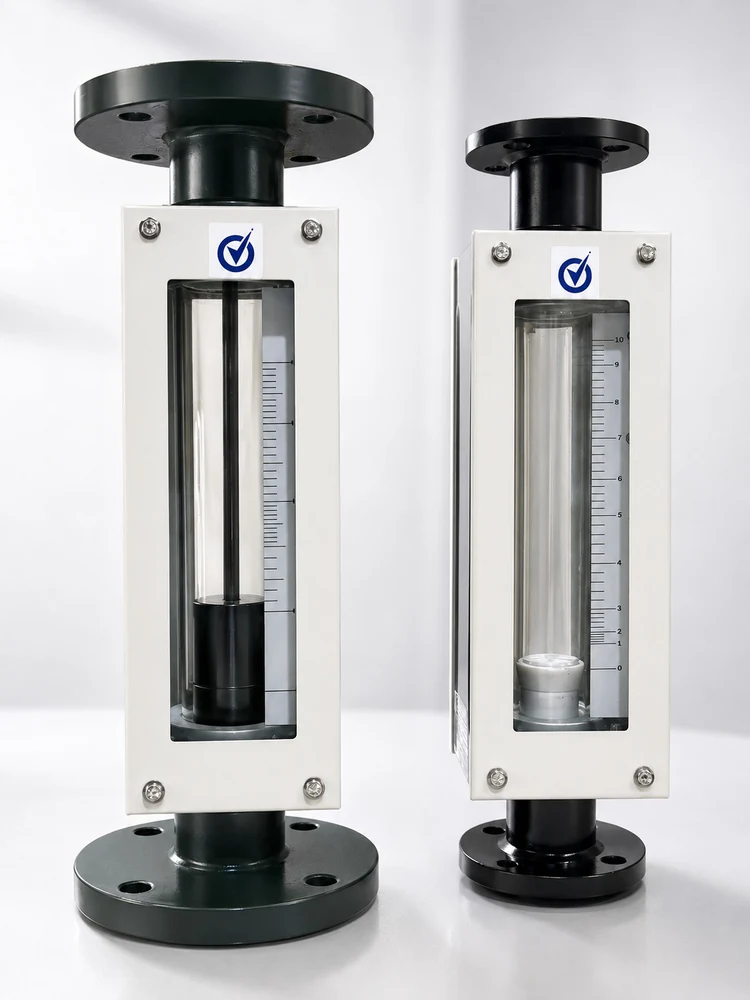
A float rises inside a tapered borosilicate tube until the forces balance. The position of the float gives the flow rate directly on the scale—simple, visible and independent of a power supply.
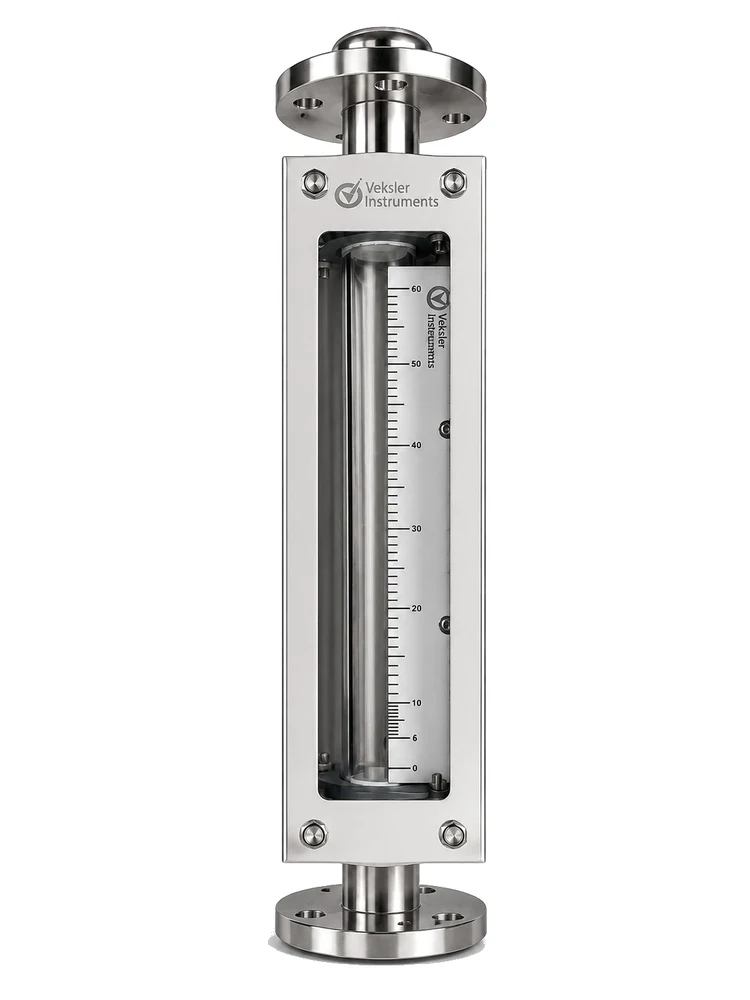
A float rises inside a tapered borosilicate tube until the forces balance. The position of the float gives the flow rate directly on the scale—simple, visible and independent of a power supply.
The pressure drop across the float is equal to its weight divided by its maximum cross-sectional area in the horizontal plane. Both in orifice type meter and in the Rotameter, the pressure drop arises from the conversion of pressure energy to kinetic energy and from the frictional losses.
A rotameter may therefore be considered an orifice meter with a variable aperture, and the formula derived for the orifice meter applies here with only minor changes.
The borosilicate tube can be replaced without taking the meter out of the pipeline.
A detachable scale is printed with flow in the customer's engineering units, 175 to 200 mm long.
End connections rotate through 360°, with top and bottom, rear, bottom and rear, or rear and top orientation.
Optional high and low alarms and a 4-20 mA DC output carry the reading to a panel or SCADA.
Standard product family; other materials on request
| Accuracy | +/- 2% of full scale (at calibration conditions) |
|---|---|
| Rangeability | 10 : 1 |
| Repeatability | +/- 0.5% of reading |
| Response time | Instantaneous (real-time indication) |
| Temperature coefficient | +/- 0.1% per °C (for fluids) |
| Pressure drop | Minimal at rated flow; varies with float design |
| Overall length | 500 mm in flanged versions |
| Scale length | 175 - 200 mm |
| Line sizes | 1/2″ to 4″ standard |
| Maximum flow | Up to 30,000 LPH for online installation |
| End connections | Can be rotated through 360° |
| Connection orientation | Top & bottom, rear, bottom and rear, rear and top |
| Floats | Standard interchangeable floats for a given size |
| Tube | Borosilicate glass tube |
| Float MOC | SS 304 / SS 316 / Teflon, other material on request |
| End fittings | CS, MS, SS 304, SS 316, rubber lined, PTFE lined |
| Process connection | Threaded (1/4″, 1/2″) or flanged (ASA 150 #, BS 10 Table D/E or as per customer's requirement) |
| Packing | Neoprene / Teflon / Silicon / Viton |
| Frame | MS / CS powder coated as standard, SS optional |
| Cover | MS / aluminium cover with safety glass or acrylic window |
| Bolts | CS / SS 304 / SS 316 |
| Gland housing | Cast steel, epoxy painted |
| Options | Adjustable packing gland; high and low alarms; 4-20 mA DC output; wide choice of flow ranges for individual requirement |
Flow range depends on line size, float material and fluid; the figures above describe the standard family. Confirm the calibrated range for your fluid at enquiry stage. Not compatible with steam or hot water above 90 °C, caustic soda above 20% concentration, hydrofluoric acid or fluorine gas, all of which attack the borosilicate glass. Not suitable for vacuum service; designed for positive gauge pressure only.
The tube, the float and the scale are common to every build. What changes is the body and the wetted parts, so the meter matches the fluid it has to carry.
Carbon steel frame with an epoxy paint finish, for general service.
SS 304/316 frame for corrosive or hygienic process environments.
Teflon-coated wetted parts with a PTFE float, for aggressive chemical service.
Send the fluid, flow range, line size, pressure, temperature and connection. We will confirm the tube, float, scale and calibrated range.