01
Panel Mount
VI-PGR-PFlush stainless steel bezel for direct panel or enclosure-door mounting, read face-on at the point of installation.
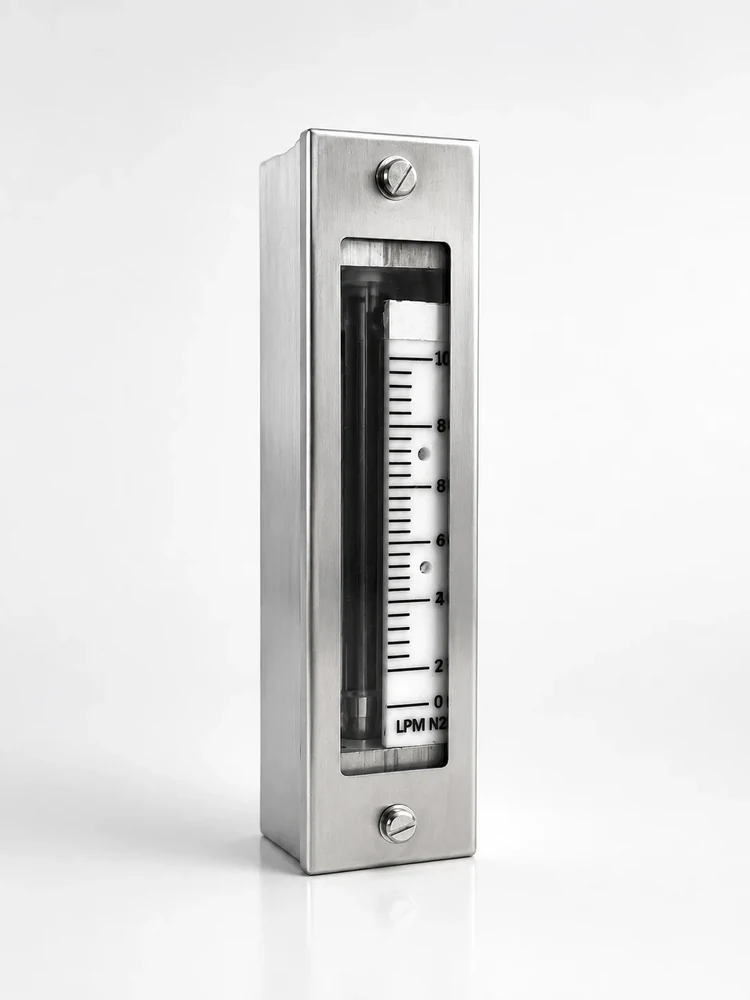
A free floating indicator inside a tapered borosilicate tube gives an instant reading of purge gas flow. Nothing to power, nothing to wire.
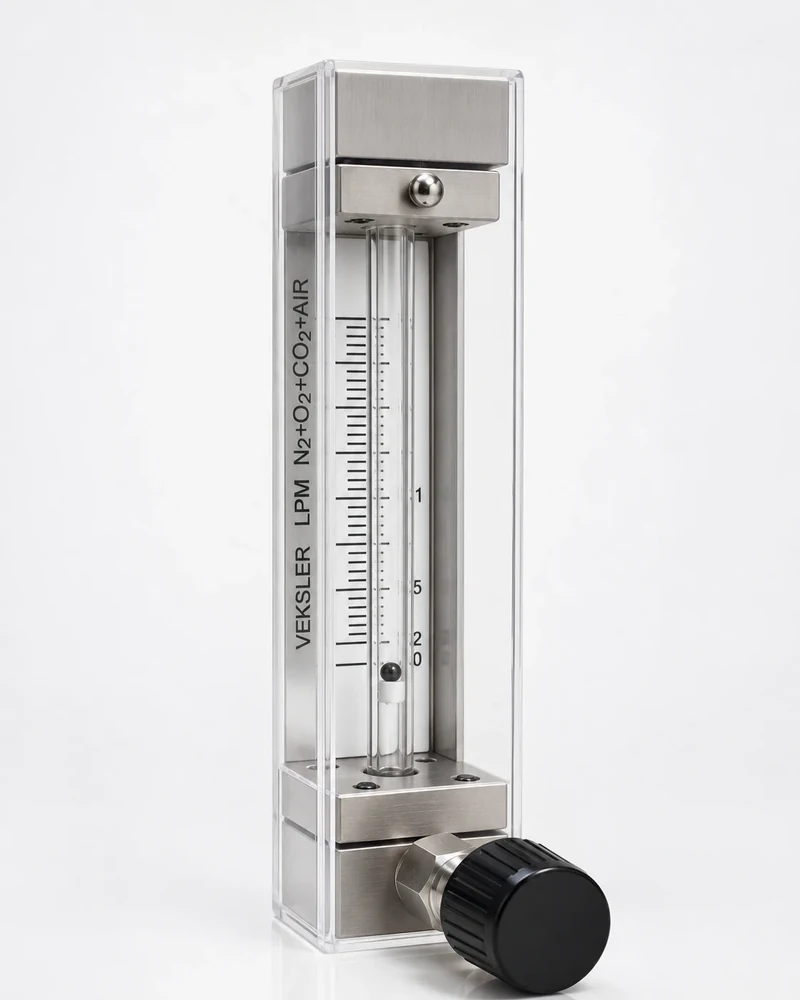
VI-PGR Purge Rotameters are variable area glass tube flow indicators used to monitor and set the flow of purge gas into instrument enclosures, analyser panels and sample conditioning lines.
A free floating indicator inside a tapered borosilicate glass tube rises and falls with flow, giving a direct visual reading with no external power. The tube is protected inside a metal frame.
Three bodies are available: a panel mounted indicator, a needle valve assembly with local flow control, and a flanged in-line unit for direct pipeline installation.
Float position balances buoyancy against flow, giving a continuous visual reading with no power supply.
A single glass tube covers a 10:1 turndown between minimum and maximum flow.
Rated to ±2% of full flow with 0.5% repeatability across the scale.
Float, packing and end fitting materials are matched to the purge gas, pressure and temperature.
Applies to all variants unless otherwise specified
| Tube | Borosilicate glass |
|---|---|
| Float | SS316, PTFE, other on request |
| Packings | Neoprene, PTFE, Silicon, VITON |
| End fitting | Mild steel, Carbon steel, SS304, SS316, CF-8M, CF8, Cast iron PTFE lined, SS lined, PVC |
| Frame and cover | Mild steel, SS (optional) |
| Accuracy | +/- 2 % of full flow |
| Repeatability | 0.5 % |
| Rangeability | 10:1 |
| Scale length | 100 ~ 125 mm |
| Max. temperature | Up to 200 °C, depending on gland packing material |
| Connections | Flanged or threaded |
| Enclosure | IP55 or IP65 on request |
Float material, scale length and enclosure rating are specified at the time of order. Maximum operating temperature depends on the gland packing material selected.
Rate of flow of air, by float material. Tube reference sets the flow range and is independent of the connection type.
| Tube ref. | 316SS float (NLPH) | 316SS float (SCFM) | PTFE float (NLPH) | PTFE float (SCFM) | Glass float (NLPH) | Glass float (SCFM) |
|---|---|---|---|---|---|---|
| 01 | n/a | n/a | n/a | n/a | 3 ~ 30 | 0.0018 ~ 0.018 |
| 02 | 4 ~ 40 | 0.003 ~ 0.03 | n/a | n/a | n/a | n/a |
| 03 | 26 ~ 260 | 0.016 ~ 0.16 | 9 ~ 90 | 0.006 ~ 0.06 | 13.5 ~ 135 | 0.0085 ~ 0.085 |
| 04 | 36 ~ 360 | 0.023 ~ 0.23 | 16 ~ 160 | 0.010 ~ 0.10 | 19 ~ 190 | 0.012 ~ 0.12 |
| 05 | 55 ~ 550 | 0.035 ~ 0.35 | 25 ~ 250 | 0.016 ~ 0.16 | n/a | n/a |
| 06 | 80 ~ 800 | 0.050 ~ 0.50 | 40 ~ 400 | 0.025 ~ 0.25 | n/a | n/a |
| 07 | 110 ~ 1100 | 0.070 ~ 0.70 | 65 ~ 650 | 0.041 ~ 0.41 | n/a | n/a |
| 08 | 185 ~ 1850 | 0.115 ~ 1.15 | 100 ~ 1000 | 0.063 ~ 0.63 | n/a | n/a |
| 09 | 300 ~ 3000 | 0.190 ~ 1.90 | 170 ~ 1700 | 0.107 ~ 1.07 | n/a | n/a |
| 10 | 500 ~ 5000 | 0.310 ~ 3.10 | 360 ~ 3600 | 0.225 ~ 2.25 | n/a | n/a |
| 11 | 800 ~ 8000 | 0.5 ~ 5.00 | 570 ~ 5700 | 0.36 ~ 3.60 | n/a | n/a |
| 12 | 1200 ~ 12000 | 0.76 ~ 7.6 | 940 ~ 9400 | 0.6 ~ 6.00 | n/a | n/a |
All figures are rate of flow of air at ambient temperature and 760 torr. Tube reference 01 is quoted with a sapphire float. PVC float and water-calibrated ranges are also available; send the medium and the flow you need and we will confirm the tube reference and float material.
All three share the same borosilicate glass tube and variable area principle, so any one reads to the same accuracy. The connection sets how the unit mounts and whether you can adjust the flow at the instrument.
Flush stainless steel bezel for direct panel or enclosure-door mounting, read face-on at the point of installation.
Acrylic-guarded body with an integrated needle valve for local flow adjustment without external plumbing.
Flanged top and bottom connections for direct in-line installation into a purge gas pipeline.
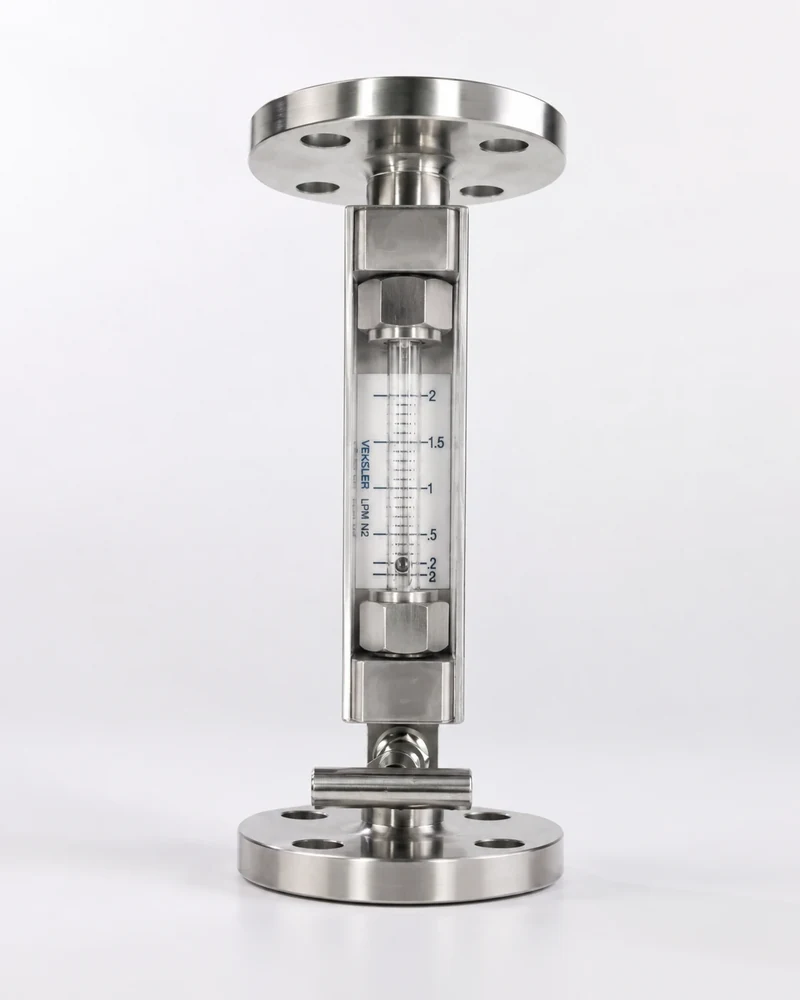
Share the purge gas, the flow range you need, the connection type and the enclosure rating. We will confirm the model, tube size and float material.