Separator duty
Widely used in refineries, gasoline plants, industrial paints, and oil and gas separators.
The float works inside the vessel and the controller is mounted at the connection. This compact arrangement is suited to separators and process vessels where level control has to happen at the vessel itself.
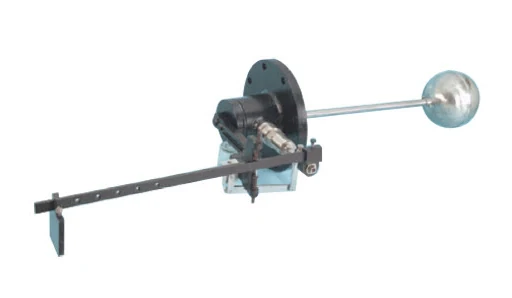
The float works inside the vessel and the controller is mounted at the connection. This compact arrangement is suited to separators and process vessels where level control has to happen at the vessel itself.
The position of the ball float is determined by fluid level variation, which actuates the rod through a system of levers. Any increase in level raises the float, helped by a counterweight in its upward movement. The mechanical link operates the plunger of the pneumatic relay, changing the output pressure which finally operates the control valve.
The pneumatic relay is made of brass and is weatherproof, which makes the instrument suitable for outdoor application and even in moist conditions.
Widely used in refineries, gasoline plants, industrial paints, and oil and gas separators.
Maximum plug turn of 50°, approximately 300 mm in terms of level.
Brass pneumatic relay in a weatherproof housing, suitable for outdoor and moist conditions.
The relay operates at 1.1 to 3.0 kg/cm² of purified, dry natural gas or air.
Standard model
| Connection | 8" NB CS, ASTM A105 flange or 2" threaded as per Russian design |
|---|---|
| Mounting | Side, internal type |
| Enclosure | Die-cast aluminium, weatherproof to IP 65 |
| Service fluid | Crude oil / oil and gas interface |
| Specific gravity | Minimum 0.7 |
| Float material and size | SS 304 / SS 316, 197 mm / 248 mm ± 5 mm dia |
| Float travel span | 300 mm with plug angle turn of 50° |
| Inlet and outlet connection | 1/4" NPT |
| Operating pressure | 40 Bar / 40 kg/cm² |
| Temperature | 120 °C |
| Supply pressure | 1.1 kg/cm² to 3.0 kg/cm², clean dry air / gas |
| Output | On-off (proportional) |
| Action | Direct and reverse |
Not recommended in turbulent and foaming fluids. For those duties a displacer-based controller is the better choice.
Share the vessel details, medium, specific gravity, pressure, temperature and required control action. We will confirm the float and controller arrangement.