Bins, hoppers and silos
Mounted in bins, hoppers and silos to control level, filling and emptying.
A small motor turns a paddle inside the vessel. When solids build up around it, the motor movement changes and the switch gives the level signal.
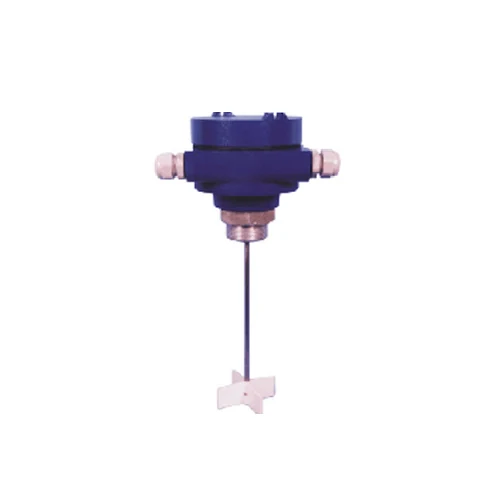
A small motor turns a paddle inside the vessel. When solids build up around it, the motor movement changes and the switch gives the level signal.
When the material level drops, the loaded tension spring returns the motor to its original position and the unit is reactivated.
Heavy duty, and suitable for level detection of dust, granules and free-flowing solids up to 10 mm.
Mounted in bins, hoppers and silos to control level, filling and emptying.
One to four vanes depending upon the specific gravity and particle size of the medium.
Minimum medium specific gravity of 0.04 kg/m³.
Agriculture, chemical and food industries among the common application areas.
Standard model; other process connections on request
| Enclosure | Polymer / cast aluminium |
|---|---|
| Probe length | 150 mm standard, extension up to 3 mtrs |
| Revolution | 1 to 2 per minute |
| Ambient temperature | −40 °C to +65 °C |
| Wetted parts | Galvanised mild steel, stainless steel, plastic (glass reinforced) |
| Material of vanes | Galvanised mild steel, stainless steel |
| Number of vanes | 1 – 4 depending upon the sp. gravity and particle size |
| Process connection | 1½" / 1" BSP (standard), others on request |
| Medium specific gravity min. | 0.04 kg/m³ |
| Medium temperature | 40 °C to +90 °C |
| Electrical cable gland | PG – 16, 2 nos. (polymer) |
| Medium pressure | 2 bar max |
| Output | 1 SPDT 230 V AC, 10 A (standard); 2 x SPDT (optional) |
| Power supply | 230 V AC, + 15% |
Suitable for level detection of dust, granules and free-flowing solids up to the size of 10 mm.
Share the material, bulk density, vessel size, temperature and insertion length. We will select the paddle and mounting arrangement.