01
Threaded
VI-RLT-TCompact thread connection for direct mounting on smaller nozzles and pipe fittings.
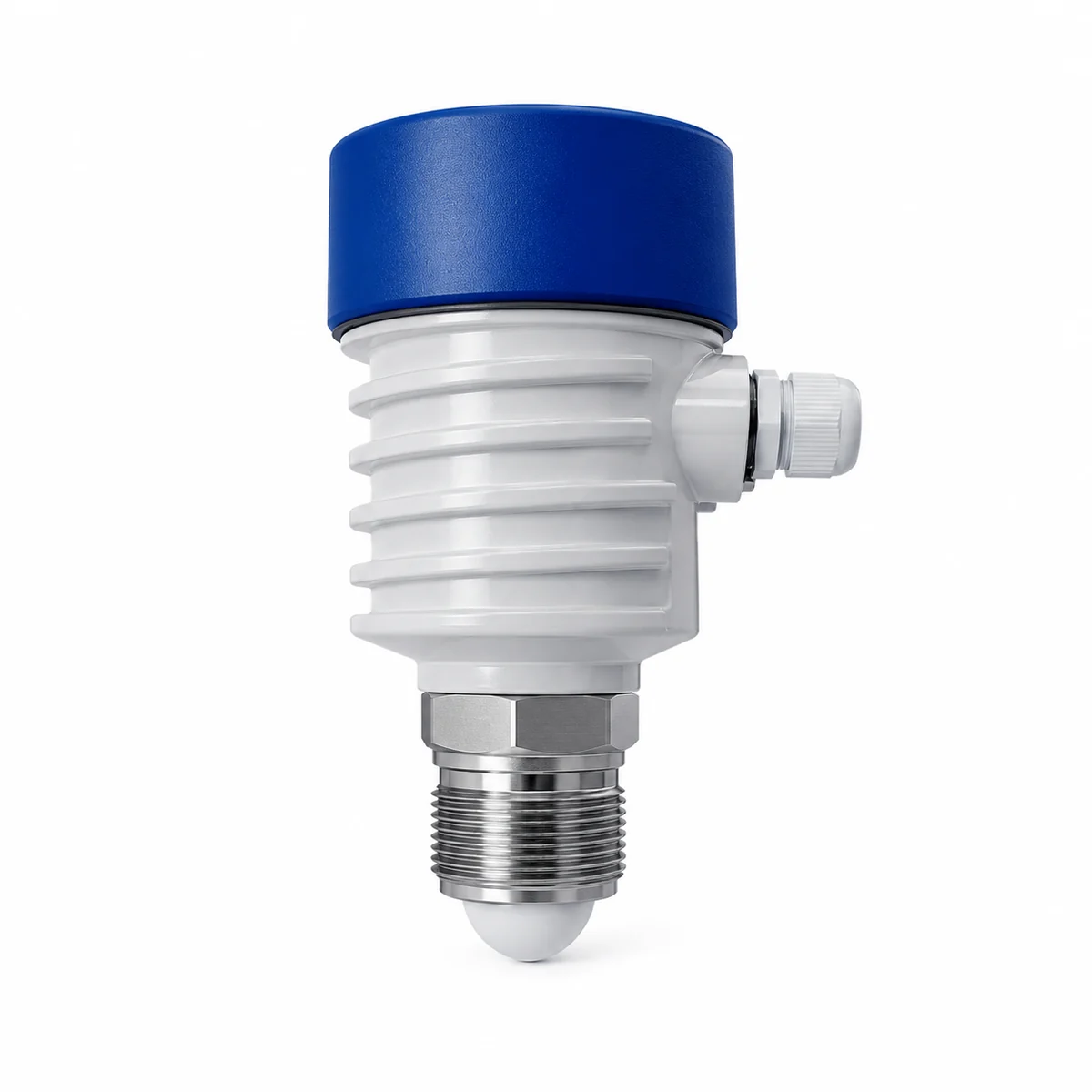
The radar signal travels down to the surface and back. Because it does not depend on contact with the liquid, it can keep working through vapour, dust and changing surface conditions.
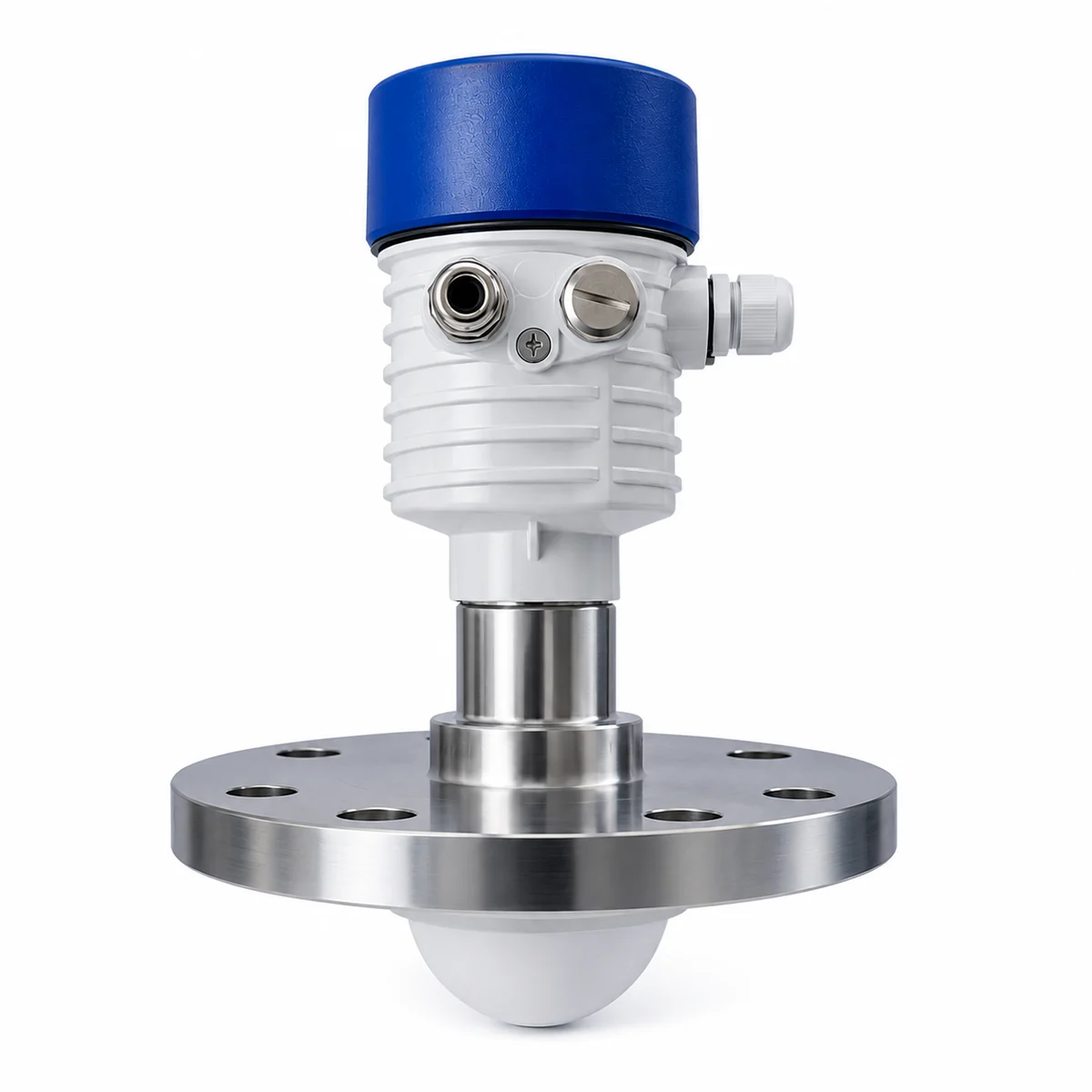
The radar signal travels down to the surface and back. Because it does not depend on contact with the liquid, it can keep working through vapour, dust and changing surface conditions.
The higher operating frequency and shorter wavelength suit solid-state applications, and the lens-focused beam performs reliably in high-dust environments and process temperatures up to +200 °C. The transmitter mounts by thread or flange for straightforward installation.
The narrowest beam on offer minimises the impact of vessel internals, so aiming rarely needs a special flange.
Self-developed millimetre-wave chips give a smaller footprint, a higher signal-to-noise ratio and a smaller blind spot.
A 5 GHz working bandwidth delivers higher measurement resolution and repeatable accuracy.
The narrowest beam on offer minimises the impact of vessel internals, so aiming rarely needs a special flange.
Choose the measuring range that matches the vessel, from 0-8 m up to 0-70 m.
Applies to both process connections
| Measuring range | 0 ~ 8 m, 0 ~ 15 m, 0 ~ 22 m, 0 ~ 30 m, 0 ~ 70 m |
|---|---|
| Measurement accuracy | ±1 mm |
| Beam angle | 3°, 8° |
| Transmission frequency | 76 ~ 81 GHz, FM sweep width 5 GHz |
| Minimum dielectric constant | ≥ 2 |
| Power supply | 18 ~ 28 VDC, four-wire system (<1 W) |
| Communication | HART / MODBUS bus |
| Output | 4~20 mA (with HART) or RS-485 |
| Process pressure | −0.1 ~ 2 MPa |
| Process / ambient temperature | −40 °C ~ 85 °C ambient; lens beam rated to +200 °C process |
| Enclosure | Aluminium alloy, stainless steel, IP68 |
| Installation | Thread or flange |
A lens antenna cover, anti-corrosion antenna, antenna heat dissipation paste and quartz isolation flange plate are available as order-time options.
Both versions share the same sensing core and performance parameters. Choose the connection that matches the nozzle.
Compact thread connection for direct mounting on smaller nozzles and pipe fittings.
Flanged process connection for larger vessels and standard-flange nozzles.
Share the vessel geometry, medium, dielectric constant, temperature and nozzle details. We will confirm the radar configuration and mounting.