Non-contact sensing
The probe never touches the medium, so wear and failure rates stay low.
The sensor stays above the liquid. It sends an ultrasonic pulse, listens for the echo and turns the travel time into a level reading.
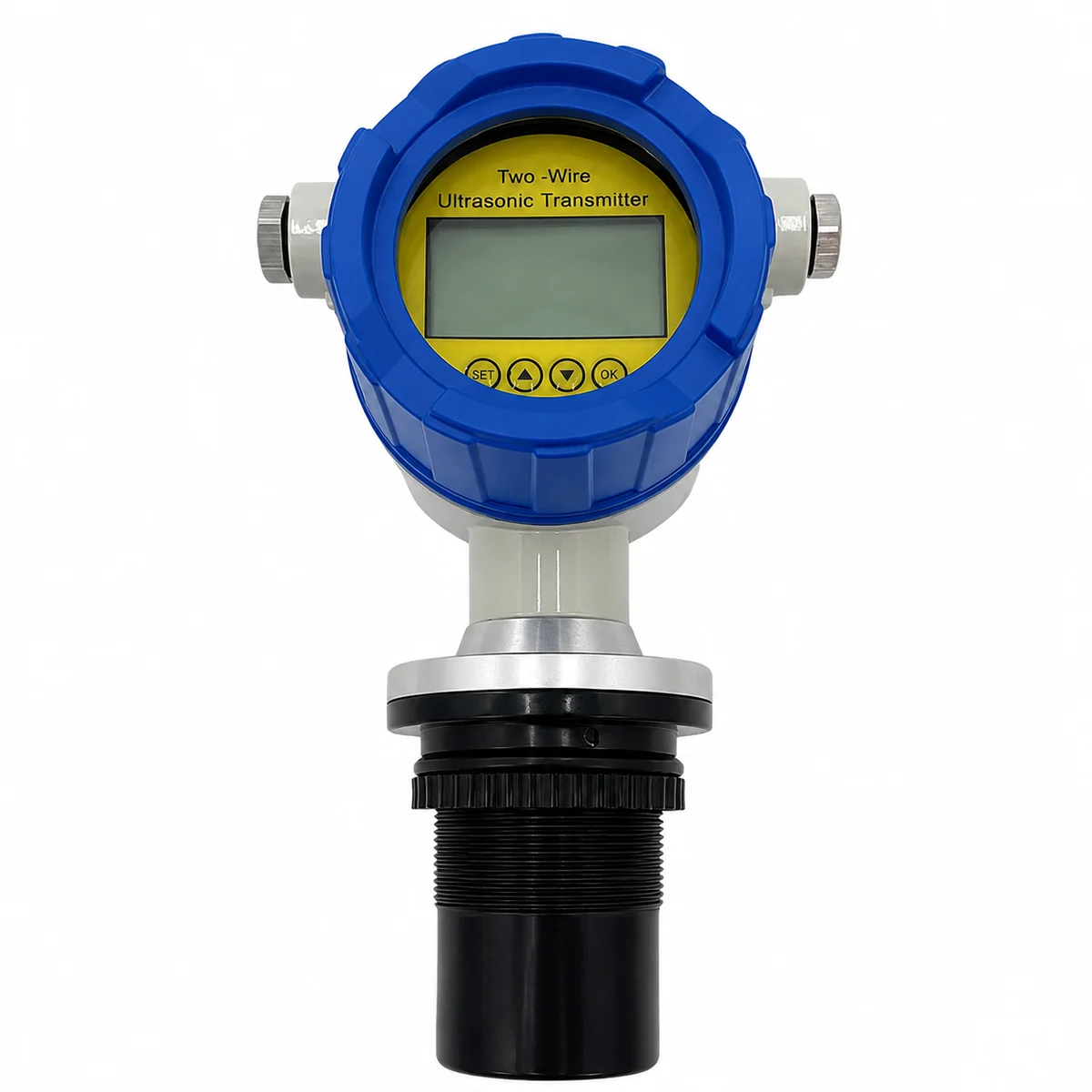
The sensor stays above the liquid. It sends an ultrasonic pulse, listens for the echo and turns the travel time into a level reading.
The result is a stable, accurate reading that resists interference and holds up in acid, alkali, saline, corrosive and high-temperature environments, with real-time data available to any connected DCS.
Open tanks and reservoirs · process vessels · acid and alkali media · saline and corrosive liquids · high-temperature service · DCS and SCADA integration.
The probe never touches the medium, so wear and failure rates stay low.
Patented acoustic software reads the return echo and adapts automatically, with no manual debugging.
0.3% accuracy and 1 mm resolution hold steady even with strong interference.
Every input and output line carries lightning and short-circuit protection as standard.
Headline figures for the standard VI-ULM configuration
| Measuring range | 0 ~ 15 m (selected to the actual application) |
|---|---|
| Blind zone | 0.35 ~ 0.5 m |
| Ranging accuracy | 0.3 % under standard conditions |
| Range resolution | 1 mm |
| Pressure rating | Below 4 atmospheres |
| Display | Self-contained LCD, liquid level or spatial distance |
| Analog output | 4~20 mA |
| Digital output | RS485, Modbus or a customised protocol |
| Power supply | DC24V / AC220V, built-in lightning protection |
| Ambient temperature | −20 °C ~ +60 °C |
| Enclosure | IP65 |
Probe dimensions vary with measuring range. Confirm your range and installation height at the time of order so we can match the correct probe length and output configuration.
Send the tank height and medium, plus temperature and output requirement. We will check the measuring range and mounting position.