Self-cleaning
The vibration itself sheds material, so sticky powders and granules do not build up on the fork.
Two tines vibrate continuously. When powder or granules cover the fork, the vibration changes and the switch signals that the material has reached the set point.
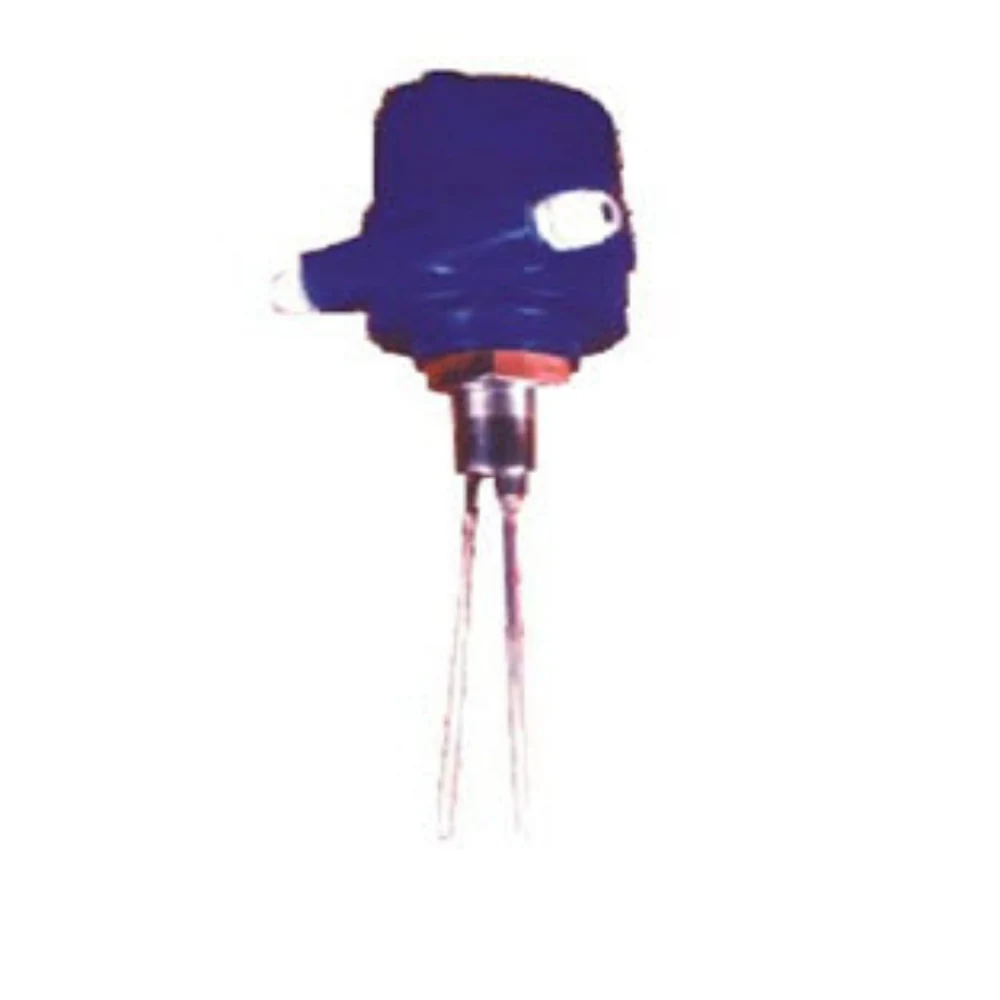
Two tines vibrate continuously. When powder or granules cover the fork, the vibration changes and the switch signals that the material has reached the set point.
The electronically stimulated fork vibrates at its mechanical resonance frequency of 125 Hz when free of the service material. Resonance is caused by piezoelectric crystals; one produces a small voltage transmitted to the switching amplifier. If the fork is covered by bulk material, damping is produced, the crystal stops producing voltage, and the amplifier switches to actuate the output.
Small depositions on the container wall do not affect operation.
The vibration itself sheds material, so sticky powders and granules do not build up on the fork.
Highly sensitive, reliable, easy to install and requiring no calibration once fitted.
SS316 forks supplied as standard, suitable for solids, powders, granules, pellets and flakes.
Economical and suitable for highly dusty environments, unaffected by incoming material.
Standard model; custom builds to order
| Operating principle | Vibration damping; electronically stimulated fork at 125 Hz mechanical resonance |
|---|---|
| Sensing element | Piezoelectric crystals with integral electronics |
| Fork material | Heavy duty SS316 |
| Available lengths | 250 to 3000 mm |
| Operating temperature | 150 °C for standard model; custom made to suit temperature up to 200 °C |
| Electronics | Supplied with integral electronics |
| Suitable media | Solids, powders, granules, pellets, flakes and other low-density bulk materials |
| Typical duty | Bins and hoppers requiring minimum and maximum level detection |
Extensively used in building, cement, food, dairy, plastic, timber, chemical and mining industries.
Share the material, density, temperature, vessel connection and insertion length. We will confirm the fork configuration.