Traceable calibration
Calibrated by comparison against master gauges, with test certificates traceable to national standard.
Pressure bends a sensing element, the movement turns that small movement into pointer travel, and the dial gives the operator a direct reading. Diaphragm options are available when the process needs isolation.
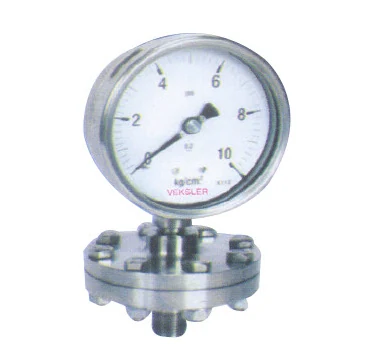
Pressure bends a sensing element, the movement turns that small movement into pointer travel, and the dial gives the operator a direct reading. Diaphragm options are available when the process needs isolation.
These are calibrated by comparison against master gauges and the accuracy is ±1% of span, with test certificates traceable to national standard.
Diaphragm type gauges are used for liquid or gaseous media in viscous, corrosive and slurry service, where the diaphragm is held between two flanges and deflects under pressure.
Calibrated by comparison against master gauges, with test certificates traceable to national standard.
Ranges up to 1000 kg/cm², and vacuum from −760 mm Hg to 0.
For viscous, corrosive and slurry service, with diaphragm and flange material selected to the fluid.
Available with chemical sealing fluid such as silicone where the process must be isolated from the element.
Bourdon and diaphragm types
| Element | C-shaped bourdon tube, closed at one end |
|---|---|
| Service | Liquid / gas / steam / oil under normal conditions |
| Accuracy | +/- 1% of span |
| Calibration | By comparison against master gauges, with test certificates traceable to national standard |
| Connection | Threaded 1/4", 3/8", 1/2" BSP / NPT |
| Range | Up to 1000 kg/cm² |
| Vacuum range | −760 mm Hg to 0 |
| Diaphragm type service | Liquids or gaseous media; viscous, corrosive and slurry service |
| Diaphragm construction | Diaphragm held between two flanges, deflecting under pressure; deflection transmitted through a link and movement to the pointer |
| Diaphragm material | Selected depending upon the type of fluid, as is the flange material |
| Chemical seal | Available with chemical sealing fluid such as silicone |
Tell us the pressure range, medium, temperature and connection. If the fluid is viscous, corrosive or likely to crystallise, mention that too.