Process isolation
Flush diaphragm protects the sensing cell from viscous, coating, crystallizing and corrosive media.
A diaphragm seal keeps difficult process fluids away from the sensing cell. The capillary carries the pressure signal back to the transmitter, making it suitable for viscous, hot or corrosive service.
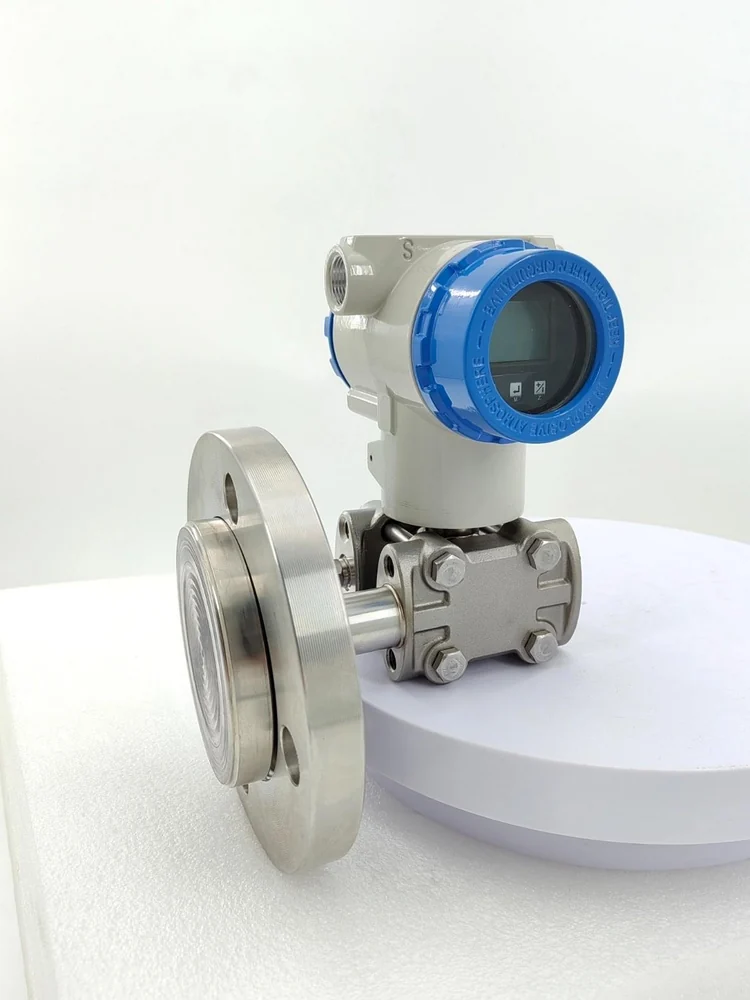
A diaphragm seal keeps difficult process fluids away from the sensing cell. The capillary carries the pressure signal back to the transmitter, making it suitable for viscous, hot or corrosive service.
Preferred where the media is viscous or polymerizing, crystallizing or plugging, corrosive, at elevated temperature, or where a sanitary flush diaphragm is required. Duties include open and closed tank hydrostatic level, vessel or reactor pressure, filter and line pressure with process isolation, and interface measurement where density is known and stable.
For an open tank, ΔP = ρ × g × h, and therefore h = ΔP / (ρ × g). For a closed or pressurised vessel, the vapour-space pressure must be measured or compensated separately.
Flush diaphragm protects the sensing cell from viscous, coating, crystallizing and corrosive media.
Direct, extended-neck or capillary configurations allow adaptation to vessel geometry and process temperature.
Loop-powered 4-20 mA architecture with optional HART supports standard plant instrumentation systems.
SS316L, Hastelloy C, Tantalum, Monel and PTFE-faced variants, checked against your concentration and temperature.
Standard product family; final limits set at order engineering
| Measurement principle | Piezoresistive / pressure-cell measurement with diaphragm-seal isolation and electronic linearization |
|---|---|
| Measuring range | Nominal family capability: 0-6 kPa through 0-10 MPa. Recommended turndown and minimum calibrated span depend on selected sensor and diaphragm seal |
| Output | 2-wire 4-20 mA standard; 4-20 mA + HART available as an option |
| Supply voltage | Typical loop-powered operation from 24 VDC |
| Accuracy | ±0.25% of Full Scale (FS) |
| Repeatability | ±0.10% of Full Scale (FS) |
| Process temperature | Standard seal assemblies typically suitable up to approximately 150 °C; high-temperature arrangements up to approximately 350 °C may be engineered with appropriate fill fluid, capillary/neck and derating |
| Process connection | DN50 and DN80 family shown; ANSI / ASME, EN / DIN, JIS and custom flange patterns can be engineered where required |
| Diaphragm materials | SS316L, Hastelloy C, Tantalum, Monel, PTFE-faced variants |
| Enclosure | Industrial field enclosure with local display option. Weatherproof / hazardous-area construction depends on ordered certification |
| Electrical entry | Threaded cable entry; size/thread specified at order (for example M20 x 1.5 or 1/2 in NPT) |
| Calibration | Factory multipoint calibration; pressure / level scaling in engineering units. Traceable calibration can be provided according to purchase specification |
Do not use generic temperature or pressure limits as flange-rating limits. The allowable working pressure must be checked from the selected flange standard and material rating and from the diaphragm-seal construction. Ordering code structure: SFLT - [Range] - [Flange] - [Class] - [Diaphragm] - [Mounting] - [Output] - [Approval].
Typical guidance; compatibility must be checked against exact composition and concentration
| Material | Typical service | Note |
|---|---|---|
| SS316L | Water, oils, utility services, many neutral process fluids | Standard choice; verify chloride concentration and temperature |
| Hastelloy C | Corrosive chemicals, chlorides, mixed acids | Good broad corrosion resistance; higher cost |
| Tantalum | Strong acids / highly corrosive media | Excellent for many acids; avoid incompatible alkalis / HF |
| Monel | Seawater, HF-compatible duties, selected alkalis | Use only after media-specific compatibility review |
| PTFE facing | Sticky / corrosive services requiring non-metallic contact | Temperature / permeation / mechanical limits must be checked |
Share the medium, pressure, temperature, flange size, fill-fluid requirement and capillary length. We will confirm the seal and transmitter arrangement.