No mercury or gas
Avoids mercury or gas filling, reducing the hazard while matching the accuracy and repeatability.
Two bonded metals expand differently as temperature changes. That movement drives the pointer directly, giving you a self-contained temperature reading with no power or electronics.
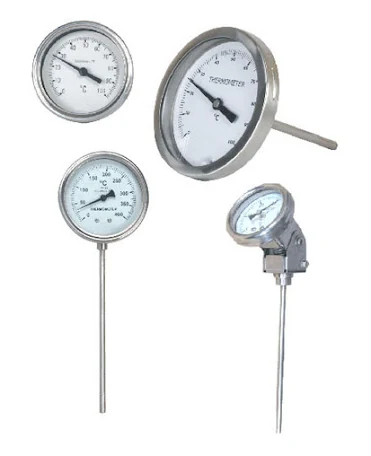
Two bonded metals expand differently as temperature changes. That movement drives the pointer directly, giving you a self-contained temperature reading with no power or electronics.
These are the most commonly used indicating temperature device, as they avoid mercury or gas filling and so reduce the threat of hazards, while still providing similar performance in accuracy as well as repeatability.
Available with rigid stem or every angle construction, the latter with external zero adjustment.
Avoids mercury or gas filling, reducing the hazard while matching the accuracy and repeatability.
Rigid stem and every angle types, with external zero adjustment on the every angle version.
SS304 case and bezel weatherproof to IP-55 and IP-65 per IEC-60529, or drawn steel black powder coated.
Direct bottom, direct back, every angle or flush panel back entry.
Standard model; options to order
| Type | Rigid stem and every angle (external zero adjustment with every angle version) |
|---|---|
| Nominal size | 63 mm, 100 mm and 150 mm |
| Accuracy class | +/- 1% of FSD |
| Case and bezel | SS304 weatherproof to IP-55 and 65 as per IEC-60529, drawn steel black powder coated |
| Sensitivity | 0.2% of range span |
| Bourdon material | Chrome-Moly steel (STD), stainless steel (optional) |
| Bulb and stem dia | 6 mm, 8 mm, 10 mm (STD) and 12 mm (optional) |
| Connection | 1/2" BSP / NPT adjustable, others optional |
| Max. stem length | 1000 mm |
| Mounting | Direct bottom, direct back, every angle, flush panel back entry |
| Pointer | Micrometer zero adjuster type |
| Standard ranges | 0-50, 100, 120, 150, 200, 250, 300, 400, 500, 550 °C and compound |
Optional accessories: shatterproof or toughened glass, maximum pointer, silicone filling, special dial design and thermowells.
Share the temperature range, dial size, stem length and process connection. We will confirm the suitable thermometer.