Two adjustments
Temperature set point control and proportionality control, the latter calibrated from 5 to 60 °F.
The sensing element responds to temperature and the controller uses a pneumatic signal to regulate the process. No electrical supply is needed in the control loop.
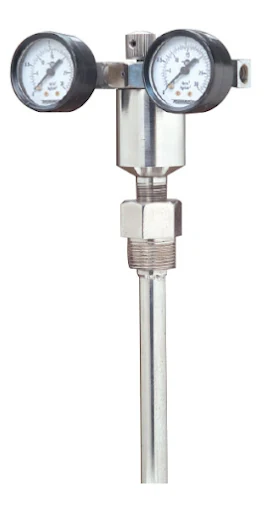
The sensing element responds to temperature and the controller uses a pneumatic signal to regulate the process. No electrical supply is needed in the control loop.
The sensor element consists of a bi-metal combination having different thermal expansion coefficients. The inner metal rod expands on a rise in temperature and contracts on a decrease, while the outer tube has a low expansion coefficient. The opposite end of the inner rod pushes against a floating link held concentric with a spring loaded inner valve, tilting the valve plug and changing the output signal.
The orifice in the seat is eccentrically drilled, so rotating the seat moves the orifice with respect to the adjusting screw and regulates the opening against temperature change.
Temperature set point control and proportionality control, the latter calibrated from 5 to 60 °F.
The sensing element is installed directly in the process vessel, with an SS316 thermowell.
Runs on a 1.4 kg/cm² air supply, so it suits hazardous and remote installations.
An increase in temperature decreases the output, driving the control valve toward closed.
Standard model
| Connection | 3/4" NPT (M) |
|---|---|
| Thermowell MOC | SS 316 |
| Length | 300 mm |
| Service | Oil / water |
| Operating pressure | 20 Bar or kg/cm² |
| Temperature range | −50 to 750 Deg F |
| Proportionality control | Calibrated from 5 to 60 °F |
| Supply pressure | 1.4 kg/cm² |
| Output | 0.2 to 1 kg/cm² |
| Pneumatic connection | 1/4" NPT |
| Action | Reverse (increase in temperature will decrease output) |
Share the temperature range, set point, sensing arrangement and control-valve details. We will confirm the controller and pneumatic output.