Metallurgy to the process
SS304, SS316, SS310, SS446, Ceramics 610, recrystallised alumina, nickel, Inconel 600 or any other.
An RTD uses the predictable change in electrical resistance with temperature. The sensor can be built in different diameters, sheath materials and thermowell arrangements to suit the process.
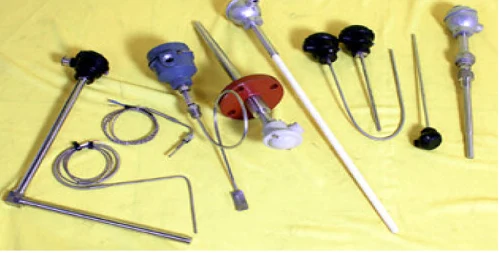
An RTD uses the predictable change in electrical resistance with temperature. The sensor can be built in different diameters, sheath materials and thermowell arrangements to suit the process.
Sensors are supplied with or without thermowells. The thermowells are made from drilled bar stock or fabricated from tube or pipe with threaded or flanged connection, and the shank may be straight or tapered.
A thermocouple is the alternative where the temperature is higher than an RTD will reach. We build both.
SS304, SS316, SS310, SS446, Ceramics 610, recrystallised alumina, nickel, Inconel 600 or any other.
From 1.5 mm up to 22 mm and beyond, depending on the process requirement.
Drilled bar stock or fabricated from tube or pipe, with threaded or flanged connection.
Shank profile selected for the flow conditions and the insertion length.
Sensors and thermowells
| Metallurgy | SS304, SS316, SS310, SS446, Ceramics 610, recrystallised alumina (Ceramics 710), nickel, Inconel 600 or any other |
|---|---|
| Diameter | From 1.5 mm to 22 mm and more depending upon the process requirements |
| Thermowell | Supplied with or without. Made from drilled bar stock or fabricated from tube / pipe |
| Thermowell connection | Threaded or flanged |
| Thermowell shank | Straight or tapered |
Sensor type, element configuration, insertion length and head arrangement are set at order against your process data.
Share the temperature range, medium, insertion length, sheath material and connection. We will recommend the RTD and thermowell arrangement.